
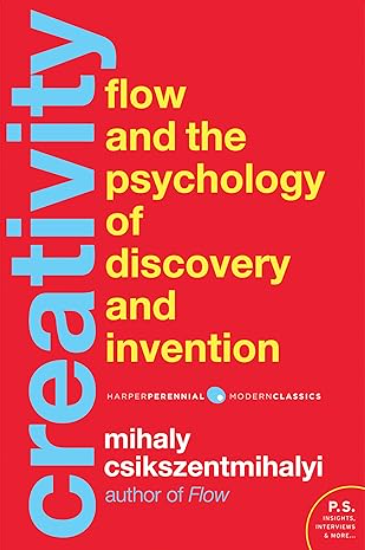
Without creativity, it would be difficult to distinguish humans from other animals. Creativity leads to a fuller, more satisfying life. Without creativity, mankind would not progress. Csikszentmihalyi points out that creativity cannot be understood by looking only at the people who appear to make it happen. Creative ideas need a receptive audience to record and implement them. And without the assessment of competent outsiders, we cannot decide whether the claims of a self-styled creative person are valid.
Creativity results from the interaction of a system consisting of three elements: a culture that contains symbolic rules, a person who brings novelty into the symbolic domain, and a field of experts who recognize and validate the innovation. Creativity is the process by which a symbolic domain in the culture is changed. So we must learn the domain well. To master a domain, we must pay attention to the information to be assimilated. Bulk of our attention is committed to the tasks of surviving from one day to the next. And we do not do much with the small amount of attention left over because of the lack of focus. Diffused thinking leads to lack of concentration. Creativity is possible only when we are able to focus attention on the problem at hand.
Each of us is born with two contradictory sets of instructions: a conservative tendency, made up of instincts for self-‐preservation, self-‐aggrandizement, and saving energy, and an expansive tendency made up of instincts for exploring, for enjoying novelty and risk. We need both. But whereas the first tendency requires little encouragement, the second can wilt if it is not cultivated. If too few opportunities for curiosity are available, if too many obstacles are placed in the way of risk and exploration, the motivation to engage in creative behaviour is easily extinguished. Sustaining high levels of curiosity is the starting point of creativity
Reviews
There are no reviews yet.